
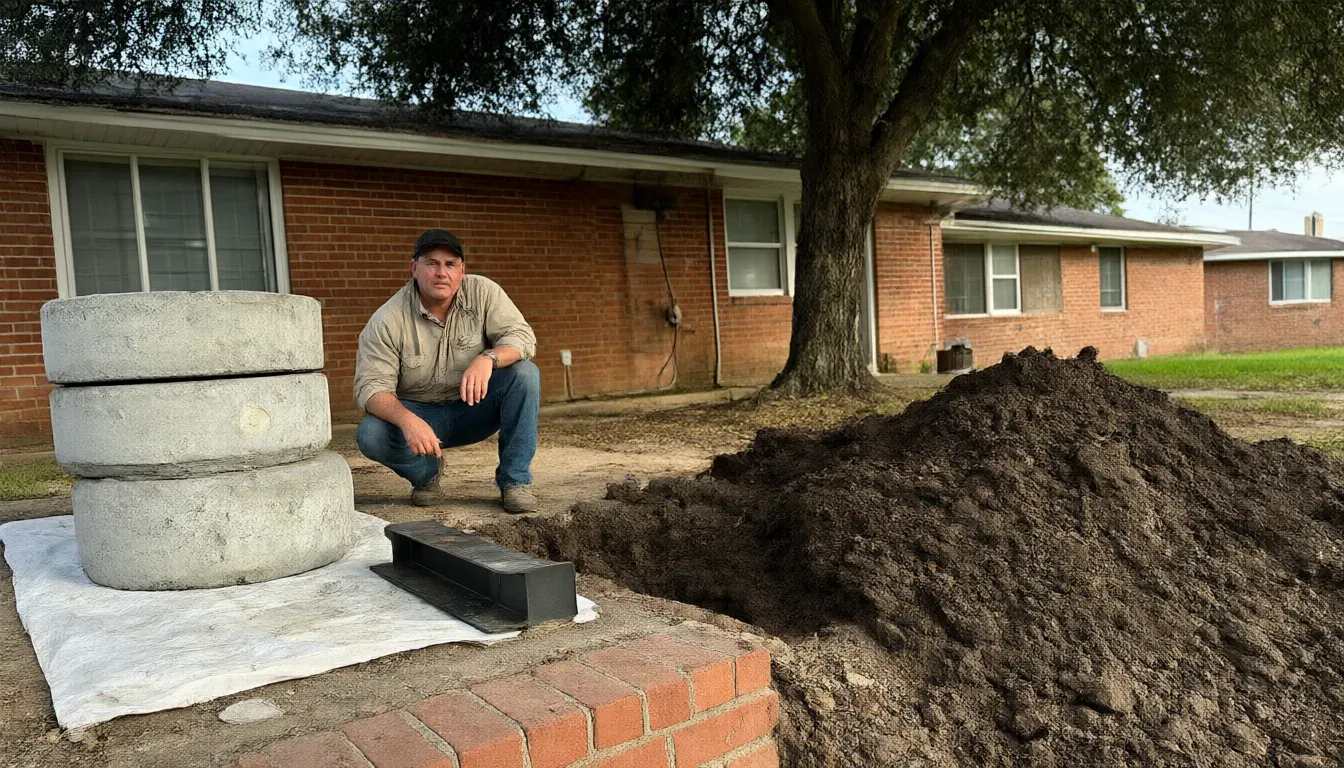
Garland Superior Foundation Repair | Slab Foundation Repair, Pier and Beam Repair & House Leveling for Homes and Businesses
Garland Superior Foundation Repair handles foundation repair in Garland, TX, from slab foundation repair and pier and beam foundation repair to house leveling, foundation crack repair, drainage correction and under-slab plumbing tunneling. We lift with pressed concrete pilings, drilled bell-bottom concrete piers and steel push piers, and every pressed piling goes down to refusal, usually 12 to 18 feet into the clay. Owner Ray Castillo has run the company since 2004, and our crews have repaired 4,100+ foundations.
Most of our work is on houses that are already moving, so every job starts with a free inspection and a digital elevation map, not a pier count. Texas has no statewide license for foundation contractors, so we pull city permits where they're required, carry general liability and workers' comp insurance, and have an independent Texas-licensed engineer review every pier job. Every lift ends with a plumbing static test, and every pier we install carries a lifetime transferable warranty.
Get a FREE Estimate
Or call (972) 885-6239
Why Garland Homeowners Pick Us as Their Foundation Contractor
22 Years in Garland, 4,100+ Foundations, Fully Insured
Owner-run since 2004, city permits pulled where required, liability and workers' comp on every crew.
Pilings $350 to $525, Count Set by the Map, Not a Quota
We price the pilings the elevation survey and engineer call for. No full-perimeter upsell on one corner.
Free Inspection, Engineer Letter Included on Pier Jobs
The elevation map costs nothing, and the independent engineer's letter is built into every pier price.
Inspection in 2 Business Days, Most Lifts in 1 to 3 Days
Crews start 7 to 12 business days after you sign, sooner for an active leak or a door that won't latch.
Cabled Pressed Pilings, Lifetime Transferable Warranty
6 by 12-inch precast cylinders on a steel cable, pressed to refusal under the weight of the house.
Residential Foundation Repair Services in Garland
Most houses need two or three of these, rarely all ten.
Slab Foundation Repair
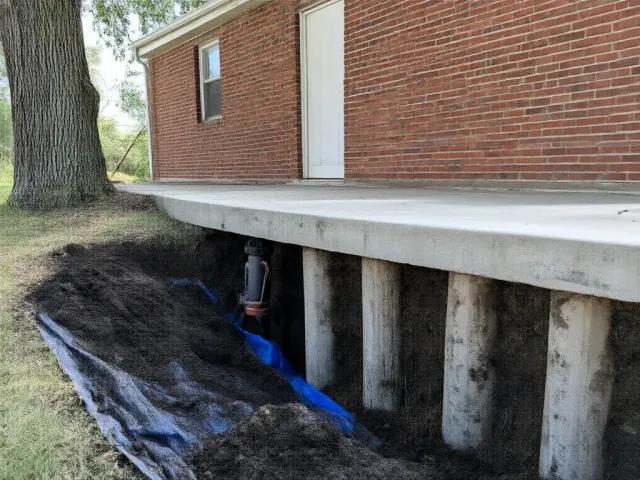
Most Garland slabs from the 1950s through the 1980s are conventionally reinforced, and when the clay under a corner dries out, the grade beam drops with it. We dig along the beam, press pilings 6 to 8 feet apart and lift against the elevation map. A typical single-story job runs 10 to 16 pilings.
Pier and Beam Foundation Repair
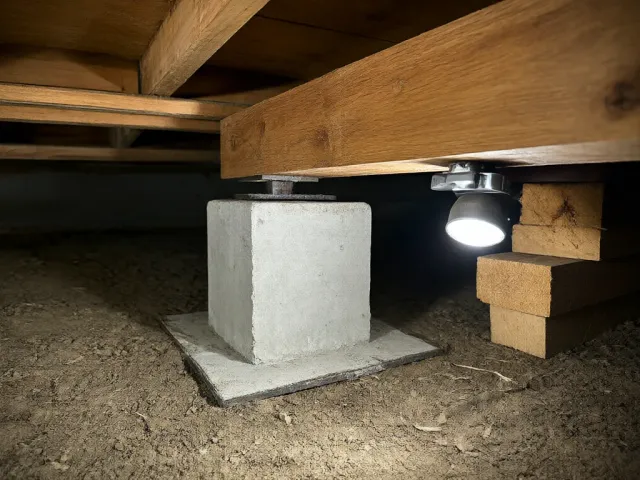
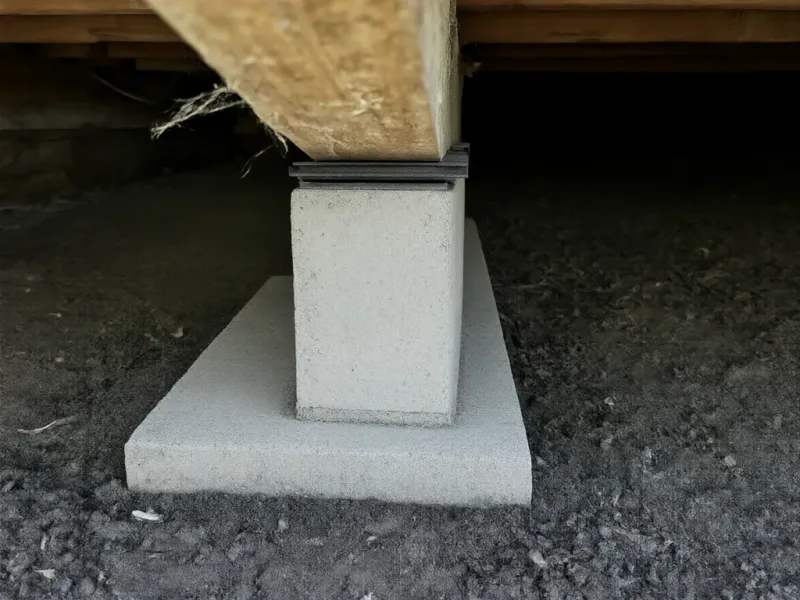
Older pier and beam houses usually fail at the wood, not the concrete: rotted blocks, crushed shims, a sill eaten by a leaking downspout. We crawl the whole space, replace failed supports with concrete pads, re-shim the girders with steel and sister sagging joists. Shim work carries 2 years of free re-shim adjustments.
House Leveling
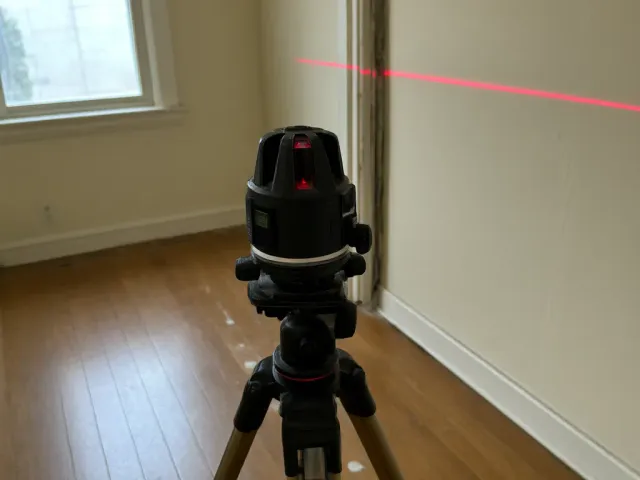
Leveling is the lift itself: how far, in what order and when to stop. We raise in small steps with the manometer running, watching doors, brick joints and drywall seams. On a house that's been out for decades, we lift until the readings stop improving, not until it's forced flat.
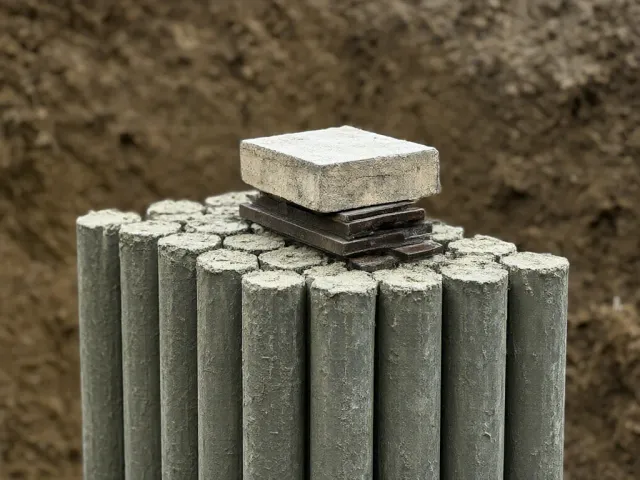
Pressed Concrete Pilings
Our standard method for single-story homes. Precast cylinders 6 inches by 12 inches are stacked on a high-strength steel cable and pressed with a hydraulic ram until they refuse to go further. Most stop between 12 and 18 feet on Garland lots, at $350 to $525 per exterior piling.
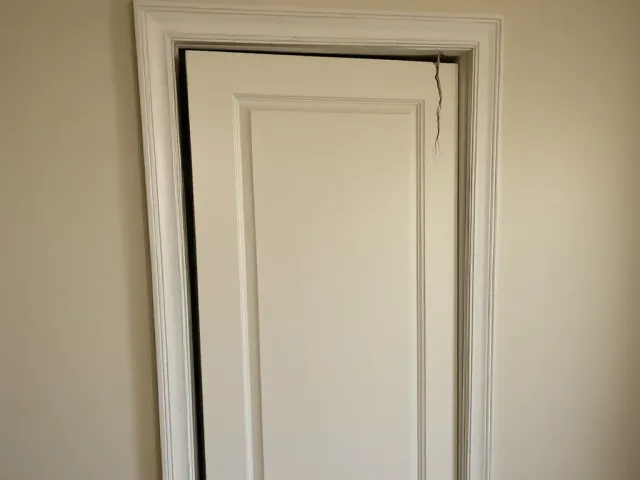
Drilled Bell-Bottom Piers
When the engineer wants a pier that resists uplift as well as settling, we drill a 12-inch shaft 10 to 13 feet down and bell out a 24-inch base. Each shaft gets four #4 rebar and 3,500 PSI concrete. They run $950 to $1,450 per pier.
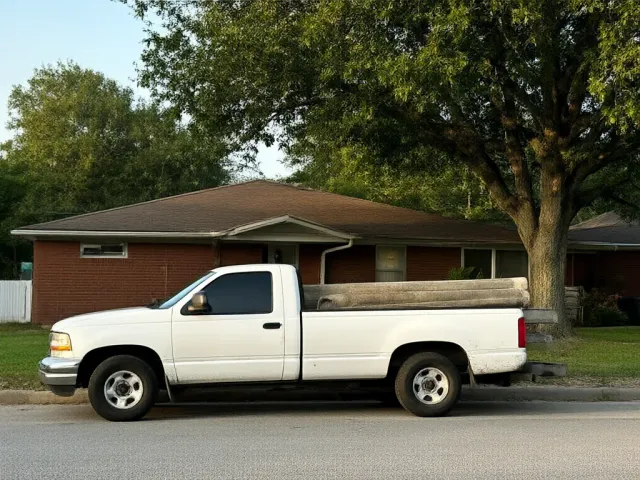
Structural Foundation Repair and Steel Push Piers
Two-story homes, stone fronts and heavy point loads need a pier with a measured capacity. Steel push piers are 3-inch galvanized pipe pushed until each one carries a measured load, and the engineer signs off on the numbers. Expect $1,300 to $1,950 per pier.
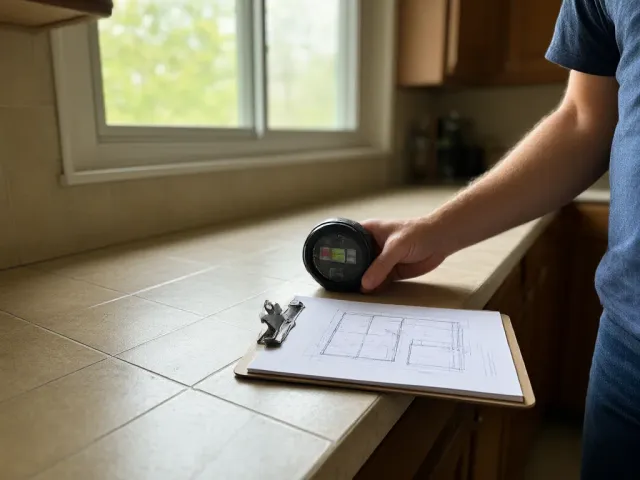
Foundation Inspections
Free, 45 to 90 minutes, and you keep the floor map. We take manometer readings every 8 to 10 feet in every room, check the slab edge and brick, and look at drainage and trees before anyone mentions piers. Some inspections end with water it and watch it, and we'll tell you so.
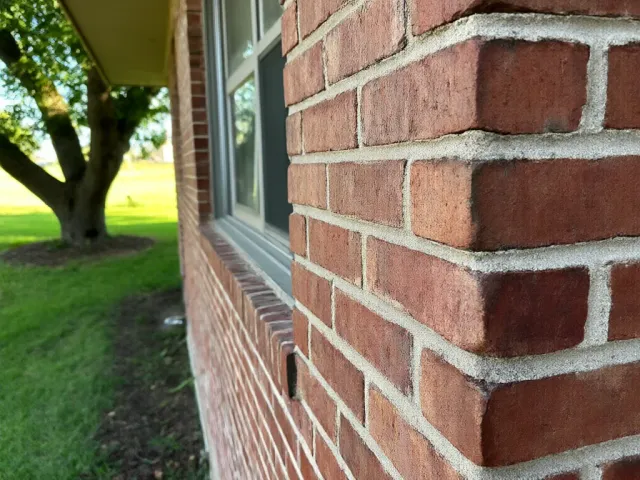
Foundation Crack Repair
A hairline in a garage slab is usually shrinkage. Anything wider than 1/8 inch, or with one side higher than the other, gets measured and logged. Structural cracks get epoxy injection at $425 to $775 per crack, and brick stair-step cracks get tuckpointed with matched mortar.
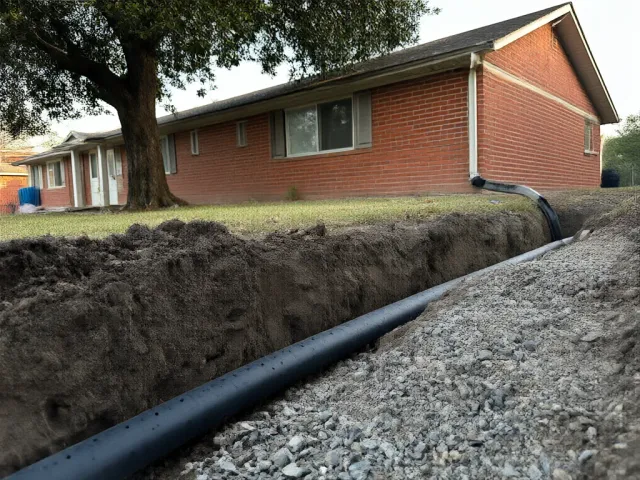
Foundation Drainage and French Drains
Water is behind more foundation calls than people think. We regrade so soil falls at least 6 inches in the first 10 feet, run downspouts to solid pipe at least 5 feet out and install French drains with 4-inch perforated pipe in washed gravel, at $38 to $62 per linear foot.
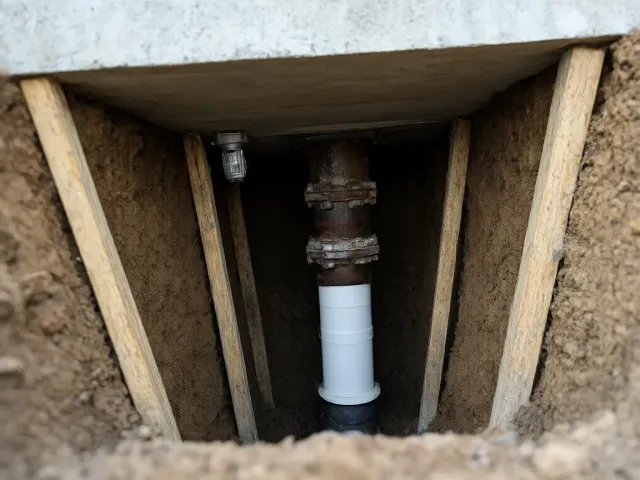
Slab Leak Repair and Under-Slab Tunneling
A leaking drain under a slab soaks the clay, and wet clay heaves. We tunnel in from outside so a licensed plumber can replace the pipe without anyone breaking up your bathroom tile. Tunneling runs $165 to $250 per linear foot, and most bath drains need 12 to 28 feet.
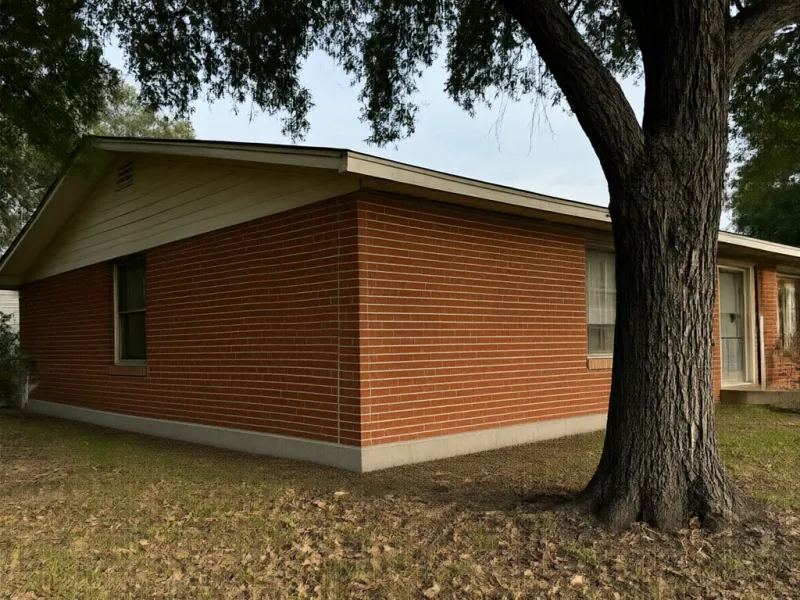
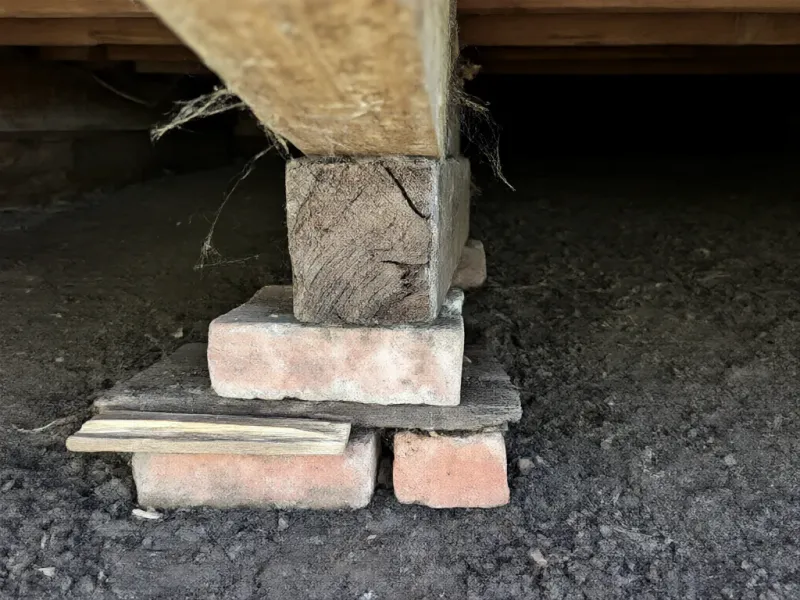
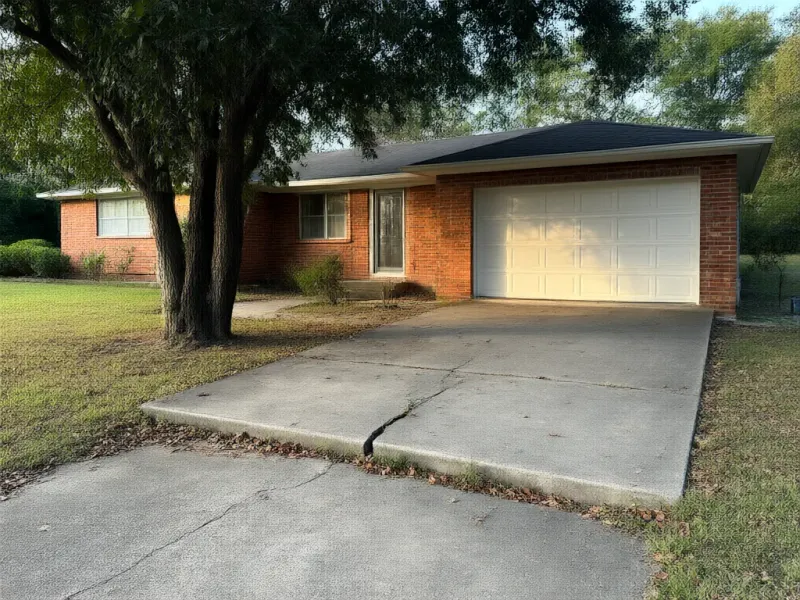
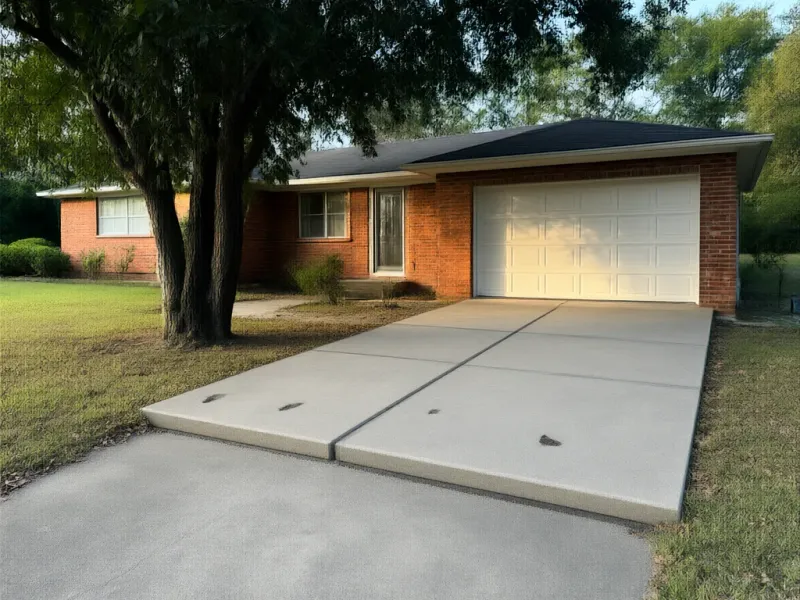
Before and After
Commercial Foundation Repair Contractors for East Dallas County Properties
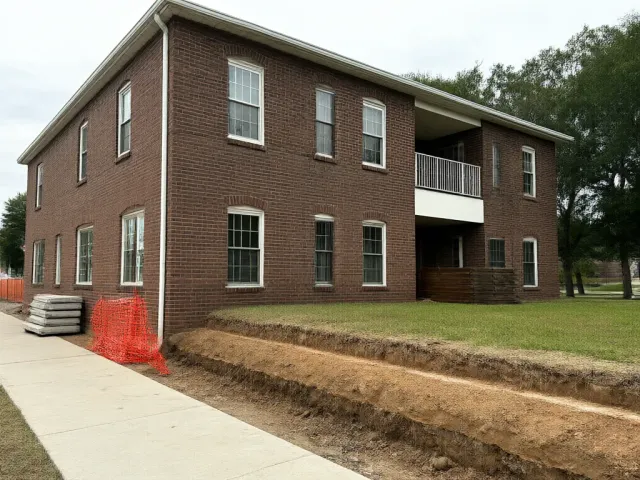
Different buildings, same clay. Commercial work is priced per project after the engineer has seen the loads.
Apartments, Fourplexes and Townhomes
We phase work one building at a time with tenants in place, give 48 hours' notice before interior work and write reports a manager can hand to an owner or lender. A duplex or fourplex pier job runs $6,800 to $15,500 per building.
Retail Strip Centers and Restaurants
Storefront slabs crack at the entries, where roof water collects and the clay swings hardest. We work from the back or after hours when a tenant can't close, with steel push piers where the engineer needs a measured load.
Churches, Schools and Offices
Big slabs with long spans move differently from a house. The engineer sets the pier layout, and we schedule around services, school calendars and office hours with a fenced, clean work zone.
Warehouses and Flex Buildings
Dock aprons, settled floor panels and cracked slab joints. We pair steel piers for the structure with polyurethane foam lifting for floor panels, which are drivable again in about 15 minutes.
Specialty Foundation and Concrete Services
These are the jobs that keep a repair from coming back.
Root Barrier Installation
A 60-mil HDPE barrier set 48 inches deep between a tree and the house cuts off the roots pulling water from under the slab. It often saves a mature pecan or live oak someone else told you to cut. Root barriers run $30 to $52 per linear foot.
Concrete Leveling and Mudjacking
Sunken driveway panels, patios and walks get lifted with mudjacking at $4 to $7 per square foot or polyurethane foam at $7 to $12. Foam goes in through 5/8 inch holes. We don't mudjack under a house.
Post-Lift Plumbing Static Tests
A licensed plumber static tests the drains the same day we lift, before we backfill. It's included on every pier job. Standalone, for a buyer checking an older house, it runs $325 to $475.
Engineer Reports for Home Sales
Inside an option period? We arrange an independent engineer's evaluation for $450 to $650, paid straight to the engineer with no markup, and we don't use it to sell you a repair.
Why Garland Keeps Calling Us Back as Its Foundation Repair Contractor
A repair only holds if it deals with the reason the house moved. After 22 years under Garland houses, the pattern is consistent: seasonal clay, slabs poured fast in the 1960s and 1970s, big trees and old drain lines.
Think of your slab as a raft on a waterbed. The raft is usually fine. It's what the water underneath does, wet in May and dry in August, that bends it. Here's how we deal with each part of that.
How a Garland Foundation Repair Job Runs
Free inspection and elevation map
We take manometer readings every 8 to 10 feet, check brick, drainage, trees and plumbing clues, and draw it all on a floor map you keep.
Engineer review and written scope
An independent Texas-licensed engineer reviews every pier job. You get the pier count, type and price in writing, and nothing changes without your signature.
Permit and utility locates
We pull the city permit where one is required, usually 2 to 5 business days, and call 811 at least two business days before we dig.
Pilings and the lift
The crew digs, presses pilings to refusal and lifts in small steps with the manometer running. Most slab jobs take 1 to 3 days.
Static test, backfill and warranty
A licensed plumber static tests the drains before backfill. You get final readings, the engineer's letter, the warranty and a free re-check at 12 months.
Blackland Prairie Clay Under Garland Slabs
Garland sits on Blackland Prairie clay, mostly the Houston Black series and its relatives. It swells when it's wet and shrinks hard when it dries, and in a dry August the cracks in a backyard are wide enough to slide a pencil into. A slab sitting on that rides every swing.
The damage usually shows at the edges first. The soil under the middle of a house stays damp while the perimeter dries out, so corners and back walls drop. That's why the bedroom door at the back of a ranch is so often the first thing that sticks.
It's also why we ask when your cracks showed up. A crack that opens in August and closes by Thanksgiving is the soil breathing. One that keeps growing through a wet spring is settlement, and that's when pilings come in.
Pressed Concrete Pilings, Cylinder by Cylinder
Each pressed piling is a stack of precast cylinders, 6 inches across and 12 inches long, threaded on a high-strength steel cable. The hydraulic ram pushes them down one at a time using the house as the reaction weight, so every piling gets load-tested by the house it'll carry.
We stop at refusal, the point where the ram can't push further without lifting the house. On Garland-area lots that's usually between 12 and 18 feet. The shallowest we've logged is 9 feet and the deepest 24, so be wary of anyone who quotes a fixed depth before the first piling goes in.
A cap block and steel shims go on top, then the lift. Steel doesn't rot or crush the way the wood shims on some older repairs did.
Bell-Bottom Piers and Steel Piers for Heavier Loads
Pressed pilings are the right answer for most single-story Garland slabs, but not every house. A two-story with a stone front, or a slab carrying a heavy point load at a masonry fireplace, needs a pier with a measured capacity behind it.
Steel push piers give us that number, because each 3-inch galvanized pier is pushed until it carries a measured load. Drilled bell-bottom piers, with a 24-inch bell 10 to 13 feet down, resist uplift as well as settling when the clay heaves. The engineer picks between them. We don't upsell either one.
1960s and 1970s Conventionally Reinforced Slabs
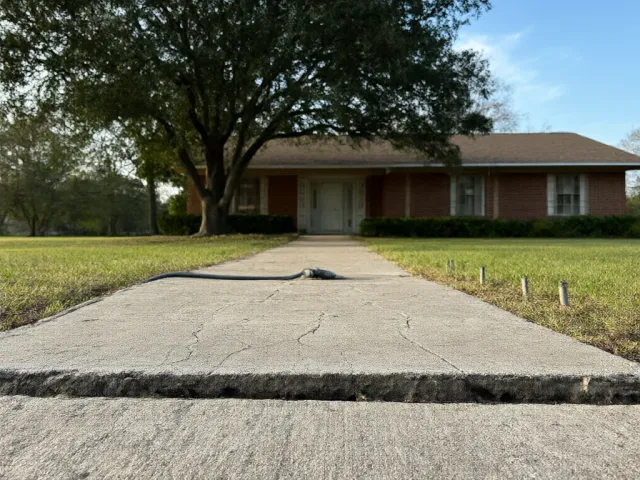
Garland grew from about 10,000 people in 1950 to 138,850 by 1980, and most houses from that boom sit on conventionally reinforced slabs: rebar or wire mesh in the concrete and a perimeter grade beam. They've held up for decades, but they don't bridge a soft spot the way a newer post-tensioned slab can.
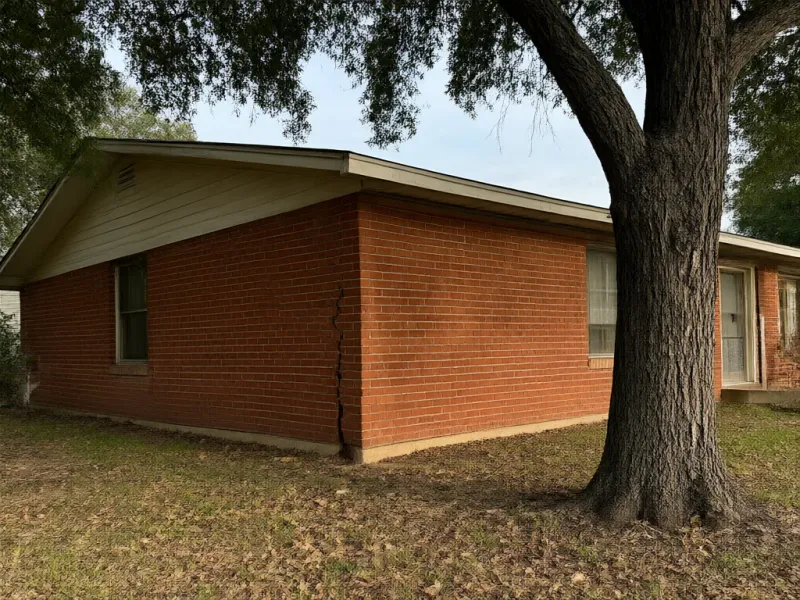
When one of these slabs moves, it tends to crack and hinge rather than tilt as a unit. You'll see stair-step cracks in the brick, a gap at the top of a window frame and a diagonal crack off a door corner, all on the same side of the house.
Newer homes around Garland are more often post-tensioned, with steel tendons under tension inside the concrete. We scan and mark tendons before any cut. Coring a post-tensioned slab blind is how a repair turns into a bigger repair.
Pecan, Live Oak and Cedar Elm Roots
Mature trees are a big part of why older Garland streets look the way they do, and they're behind a lot of our calls. A big pecan or live oak pulls a lot of water out of the clay in summer, and the soil under your back corner is part of its territory.
Cutting the tree isn't always the answer. Take out a big tree and clay that's been dry for decades can swell back up, pushing the slab the other way. A root barrier, 60-mil HDPE set 48 inches deep, usually lets you keep the tree and protect the slab.
If you're planting, plant well away from the house. A fast-growing shade tree 8 feet from the slab is a foundation problem that takes about 15 years to show up.
Cast Iron Drains and the Static Test
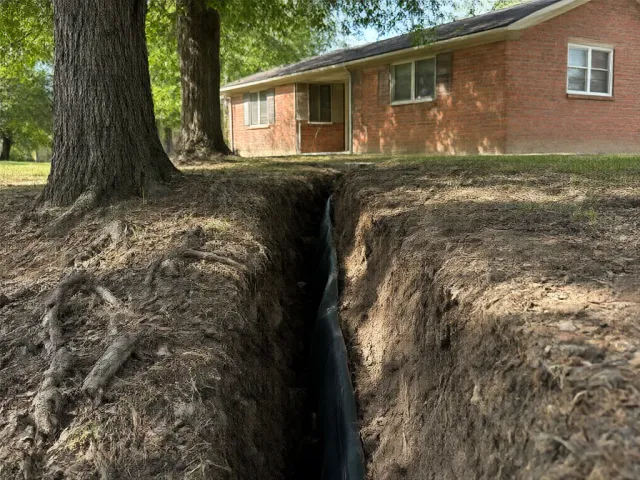
Plenty of 1960s and 1970s Garland slabs still have their original cast iron drain lines underneath, and a lot of that pipe is cracked or scaled by now. A leaking drain soaks the clay around it, and wet clay swells.
So the slab heaves up in the middle instead of dropping at the edge. Piers won't fix that. Fixing the leak will, and sometimes the honest scope is no pilings at all.
That's why a licensed plumber runs a static test on every pier job, the same day we lift and before we backfill. Lifting can stress old pipe, and you want to know while the hole is still open, not when the next water bill shows up.
Shims, Sills and Crawl Space Moisture
Pier and beam houses fail differently. Original wood blocks sitting on dirt rot out, cedar shims crush, and a downspout dumping into the crawl space year after year will eat a sill plate.
We crawl the whole space with a light and a moisture meter before pricing anything. Failed supports get concrete pads and blocks, girders get steel shims and sagging joists get sistered. A soft kitchen floor is often solid again the same afternoon.
Shims are maintenance. Wood and clay both keep moving, so shim work carries 2 years of free re-shim adjustments, and any new piers we set carry the lifetime warranty.
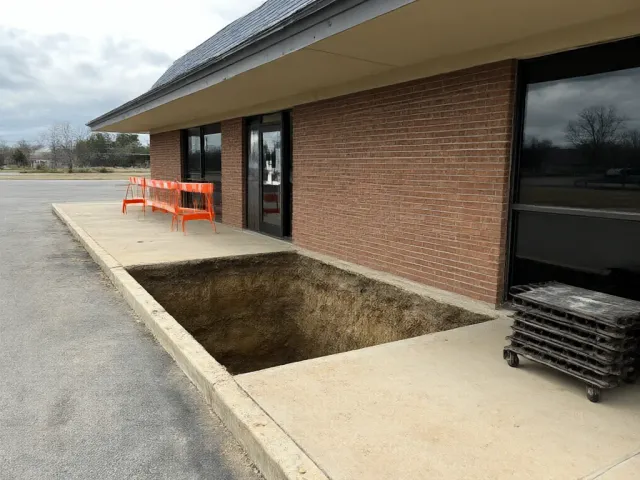
Downspouts, Grade and Standing Water
If water stands against your slab after a storm, piers are only half the fix. We want soil falling at least 6 inches in the first 10 feet away from the house, downspouts running to solid 4-inch pipe that lets out at least 5 feet away, and flower bed edging that doesn't dam water against the brick.
Where the lot is flat or a neighbor's yard drains into yours, we put in a French drain: 4-inch perforated pipe in a sock, washed 3/4-inch gravel and filter fabric, run to daylight or a pop-up emitter. Drainage work carries a 5-year workmanship warranty.
What the Lifetime Transferable Warranty Covers
Every pier and piling we install carries a lifetime warranty. If a pier we put in settles, we come back and adjust it at no charge. It transfers to the next owner free, as long as they register it with us within 30 days of closing.
It doesn't cover new plumbing leaks, drainage someone changes later, or soil left bone-dry through a drought with no watering. We put that in writing before you sign, so nobody's surprised years down the road.
We also come back at 12 months for a free set of elevation readings, so you can see whether the repair did what we said.
Foundation Repair Contractors Serving Garland and East Dallas County
Garland Superior Foundation Repair serves surrounding areas to Garland, TX, including Rowlett, Sachse, Mesquite, Rockwall, Sunnyvale and Forney.
The blocks around downtown and the Travis College Hill historic district have houses from the 1910s through 1960, and that's where most of our pier and beam work happens. The brick ranches that went up as Garland grew from about 38,500 people in 1960 to 138,850 in 1980 are our everyday slab jobs, and we're on streets from Club Hill and Eastern Hills to Spring Park, Buckingham North and the neighborhoods along Duck Creek.
North Garland around Firewheel Town Center took most of the city's 2000s growth, and those homes are more often post-tensioned. On the Lake Ray Hubbard side of town, many lots slope toward the water, so drainage comes up on almost every visit. From I-30 up to the President George Bush Turnpike, it's the same Blackland clay underneath.
- Garland, TX
- Rowlett, TX
- Sachse, TX
- Mesquite, TX
- Rockwall, TX
- Sunnyvale, TX
- Forney, TX
Foundation Repair Cost in Garland, TX
These are the ranges we're quoting in Garland and east Dallas County in 2026. Your number gets confirmed at the free inspection, in writing, before any work starts.
Most single-story slab jobs land between $4,800 and $9,200. The pier count drives the price, and it comes from the elevation map and the engineer.
| Job | Typical range | What drives the price |
|---|---|---|
| Foundation inspection with elevation map | Free | Written estimate included |
| Pressed concrete piling, exterior | $350 to $525 per piling | Engineer letter, permit handling and static test included |
| Pressed concrete piling, interior | $575 to $850 per piling | Slab cut and patch; flooring quoted separately |
| Drilled bell-bottom concrete pier | $950 to $1,450 per pier | When the engineer specifies them |
| Steel push pier | $1,300 to $1,950 per pier | Two-story homes and heavy masonry |
| Typical single-story slab job | $4,800 to $9,200 | 10 to 16 pilings |
| Pier and beam re-shim and level | $1,400 to $4,200 | Sill and joist work quoted separately |
| Under-slab plumbing tunneling | $165 to $250 per linear foot | Backfill and compaction included |
| French drain | $38 to $62 per linear foot | Pipe, gravel, fabric and outlet |
City permit fees pass through at the city's cost with no markup. If someone quotes you a full-perimeter job over the phone without measuring your floors, get a second opinion. Ours is free.
Foundation Repair Questions From Garland Homeowners
Are you searching for 'foundation repair near me'?
If you've been searching for foundation repair near me in Garland, TX, you've found a local crew. Garland Superior Foundation Repair is a Garland-based foundation repair contractor that has served Garland and the surrounding area since 2004. Call us at (972) 885-6239 or book a free foundation inspection, and if you call before 3pm we'll call back the same business day.
How much does foundation repair cost in Garland?
Most single-story slab repairs here run $4,800 to $9,200, usually 10 to 16 pressed pilings at $350 to $525 each on the outside. Interior pilings, steel piers and bell-bottoms cost more. The free inspection gets you a written number before anything starts.
How do I know if I need repair or just watering?
Pencil a mark at each end of the crack and date it. If it opens in August and closes by November, it's likely seasonal, and a soaker hose 12 to 18 inches off the slab may be all you need. If it keeps growing, or one side sits higher than the other, have it measured.
Pressed pilings or steel piers: which does my house need?
Most single-story Garland slabs do well on pressed concrete pilings pressed to refusal. Two-story homes, stone fronts and heavy point loads usually get steel push piers or drilled bell-bottoms. The independent engineer makes that call, not a salesman.
Does Garland require a permit for foundation repair?
Yes. Garland's code requires a building permit for repairs to a building, and contractors register with the city's Building Inspection Department. We pull it, and it usually takes 2 to 5 business days.
Will lifting my house damage the plumbing?
It can stress old pipe, especially cast iron under 1960s and 1970s slabs. That's why a licensed plumber static tests the drains on every pier job before we backfill. If it fails, you know right away, and we can tunnel to the leak instead of breaking up your floors.
Is the warranty transferable if I sell?
Yes. The lifetime warranty on piers and pilings we install transfers to the next owner at no charge, as long as they register it with us within 30 days of closing. Buyers' agents ask for it, so keep the paperwork with the house.
How long does a foundation repair take?
Most slab pier jobs take 1 to 3 days, and pier and beam leveling takes 1 to 2. Crews usually start 7 to 12 business days after you sign, once the engineer has reviewed the scope and the permit is in.
Book a Free Foundation Inspection in Garland
Call (972) 885-6239, Monday to Friday 7am to 5:30pm. We'll schedule your inspection within 2 business days, walk every room with the manometer and leave you a floor map and a written number.